

China Compostable Bag Breakthroughs Transforming Sustainable Packaging
2026-08-27
The global push for sustainable packaging has found an unexpected hero in China, where compostable bag innovations are rewriting the rules of waste management. From advanced biopolymers to cost-effective production breakthroughs, these developments are turning a niche eco-product into a mainstream necessity. At the forefront of this shift, CHALLENGE WOLVES is bridging the gap between Chinese manufacturing excellence and international demand for truly green alternatives. But what exactly are these breakthroughs, and why should brands worldwide pay attention now? The answer lies in a mix of material science, scalability, and a willingness to challenge the status quo—one bag at a time.
Why Guangdong’s starch-based films are outperforming petroleum plastics
Guangdong's starch-based films are gaining ground because they solve a problem petroleum plastics never could: end-of-life disposal in humid, biologically active environments. In the province's subtropical climate, conventional polyethylene and polypropylene films persist for decades, breaking into microplastics that contaminate waterways and farmland. Starch-based alternatives, by contrast, begin mineralizing within weeks under typical composting conditions, reducing the burden on landfills and informal waste channels. This performance gap matters in a region where dense urban populations and intensive agriculture create constant pressure to manage plastic residue without costly infrastructure upgrades.
Beyond degradation, the mechanical and barrier properties of Guangdong's starch films have improved enough to compete in real-world packaging and mulching applications. Local manufacturers blend thermoplastic starch with biodegradable polyesters and natural plasticizers to achieve tensile strength and tear resistance that once required petroleum feedstocks. For example, modified cassava starch sourced from nearby provinces provides film clarity and seal strength suitable for fresh produce bags, while retaining enough oxygen permeability to extend shelf life for leafy greens without condensation buildup. These technical advances remove the trade-off that earlier bioplastics forced on users.
Cost dynamics also favor Guangdong's producers. Unlike petroleum-based resins, whose prices track volatile crude oil markets, starch feedstocks benefit from stable domestic agricultural supply chains and government incentives for biomass utilization. Processing energy requirements have dropped as extruder designs and reactive blending techniques mature, narrowing the price gap with conventional films. When factoring in avoided disposal fees and potential carbon credit mechanisms in the Greater Bay Area, the total cost of ownership for starch-based films can fall below petroleum plastics for short-life packaging and agricultural mulch, driving adoption among cost-sensitive manufacturers and farm cooperatives.
The real cost story behind China’s compostable bag price plunge
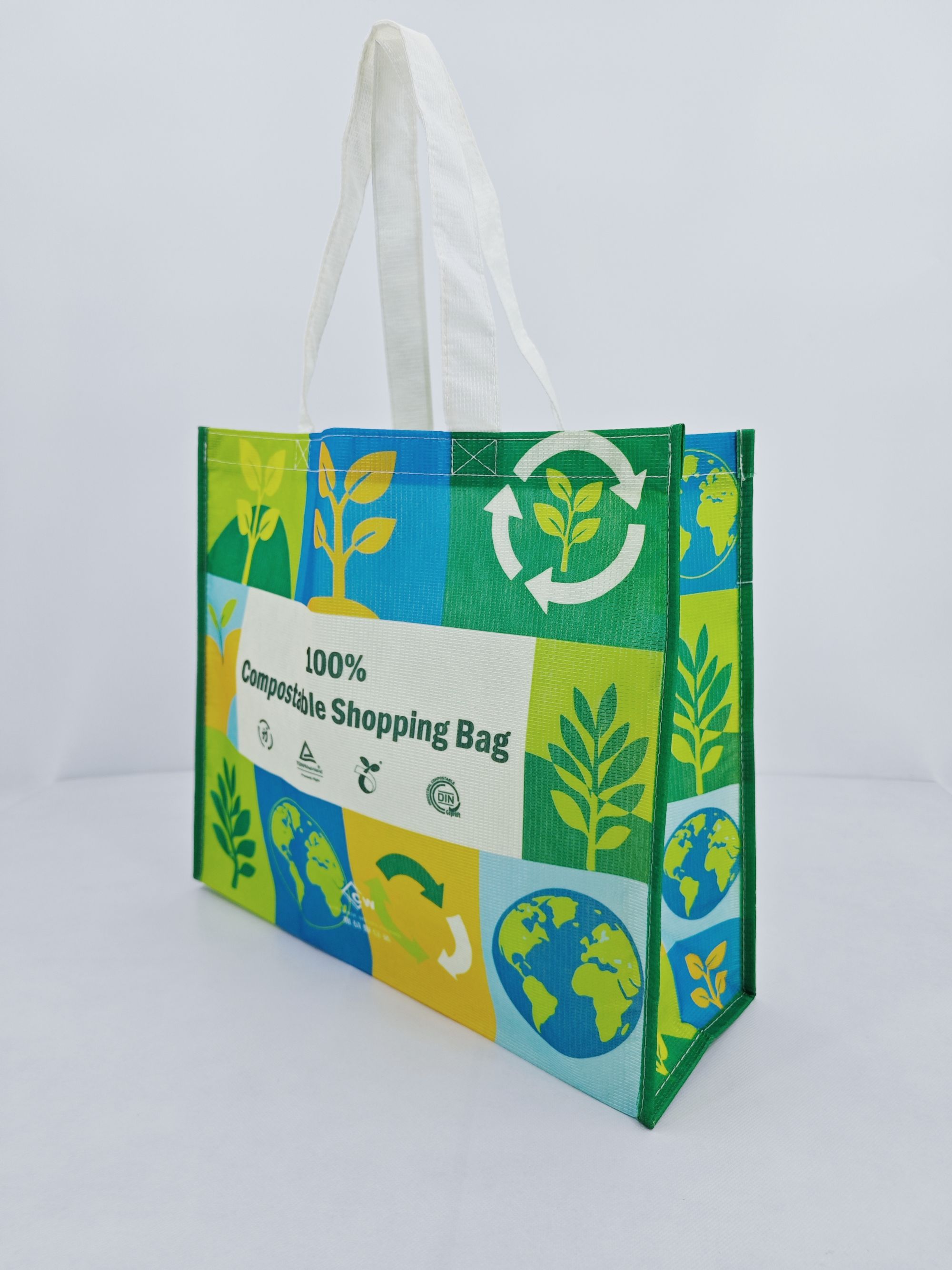
The sharp decline in China’s compostable bag prices is often framed as a triumph of green manufacturing, but the real story is one of squeezed margins, hidden subsidies, and a race to the bottom. At the heart of the drop is the falling cost of polylactic acid (PLA) and PBAT, the primary biopolymers used in these bags. Chinese chemical giants have scaled up production capacity so aggressively that domestic supply now far outstrips demand, pushing raw material prices down by nearly 40% since 2022. Yet this isn’t simply efficiency at work; much of the expansion was fueled by provincial government incentives aimed at boosting bioplastics output, creating a glut that manufacturers are now absorbing through price cuts to win export orders.
What rarely makes the headlines is the pressure this puts on smaller producers who lack vertical integration. Many bag converters purchase resin on the spot market and operate on razor-thin margins, often below 5%. To survive, some quietly blend cheaper starch-based fillers or even conventional plastics into “compostable” products, undermining the very environmental promise that justifies the premium these bags once commanded. Independent lab tests have repeatedly found that a significant share of bags labeled compostable fail to fully disintegrate under industrial composting conditions, yet enforcement remains lax because local authorities prioritize export volume over compliance.
The cost story also involves the hidden expense of certification and testing, which has become a recurring financial burden for factories serving European and North American markets. A single batch of bags may require multiple rounds of disintegration and ecotoxicity tests, costing upwards of $10,000—a sum that eats into the already depressed unit prices. Rather than raising quality, many factories respond by producing larger volumes of low-grade bags to spread the fixed costs, further driving down the global benchmark price. The result is a market where the cheapest bag often carries the highest environmental debt, a reality that buyers rarely see when comparing quotes from competing suppliers.
How PBAT and PLA blends are solving the tear-and-leak problem
Packaging engineers have long struggled with a frustrating trade-off: materials tough enough to resist tearing often fail under stress by puncturing or splitting along weak points, while those designed to be flexible and leak-proof tend to lose structural integrity when stretched. In the world of biodegradable films, this challenge has been especially acute. PBAT, a petroleum-derived but compostable copolyester, offers impressive elongation and flexibility, but it lacks the stiffness needed to prevent tearing under heavy loads. PLA, on the other hand, brings high tensile strength and rigidity from its plant-based lactic acid backbone, yet it is brittle and prone to cracking when bent. By blending these two polymers, manufacturers are finally closing the gap—creating films that combine PBAT's soft, stretchy behavior with PLA's reinforcing network, so that a package can flex without fracturing and hold liquids without weeping.
The real breakthrough lies in how the blend's morphology behaves at the microscopic level. Pure PBAT films deform easily, allowing small nicks to propagate into long tears because there is no rigid phase to stop crack growth. Pure PLA, by contrast, resists deformation so strongly that any localized stress concentrates at a single point, leading to sudden brittle failure. In a carefully tuned PBAT/PLA blend—typically with PLA content between 10 and 30 percent—the PLA forms dispersed domains or co-continuous regions that act like microscopic speed bumps for tear propagation. When a tear begins in the PBAT matrix, it must either pull through or around these stiffer PLA islands, dissipating energy and blunting the crack tip. At the same time, the continuous flexible phase allows the overall film to elongate significantly before rupture, so it can absorb impact without catastrophic failure. This synergistic mechanism directly addresses the two most common modes of package failure: puncture from sharp objects and seam splitting under internal pressure from liquids.
Commercial compostable bags and packaging liners are now using this blend strategy to replace conventional polyethylene in demanding applications such as wet food pouches, produce bags that must survive rough handling, and trash liners exposed to sharp waste. The improvement is measurable: blended films can show a 50–80 percent increase in tear resistance compared to pure PBAT, while maintaining compostability certifications under standards like EN 13432. Manufacturers also adjust the PBAT-to-PLA ratio, compatibilizer content, and processing parameters to fine-tune the balance between flexibility and strength for each use case—whether the goal is a stretchy produce bag that won't puncture on a broccoli stem or a heavy-duty liner that keeps liquid waste contained. This practical, formulation-level solution is quietly solving the tear-and-leak problem that once made bioplastics a risky choice for wet or sharp-edged contents.
Inside the policy shifts that turned Chinese manufacturers toward bio-based packaging
In 2020, Beijing rolled out a sweeping plastics directive that did more than ban single-use bags and straws. It reframed polymer materials as a carbon-management problem, not just a waste management nuisance. Provincial governments were told to build recycling infrastructure and to support alternative materials, and bio-based resins suddenly appeared in industrial planning documents alongside recycled plastics and paper.
The shift hardened after the 14th Five-Year Plan for Bioeconomy Development listed bio-based packaging as a priority sector. Tax rebates for corn-starch polylactic acid and cellulose-based films made the cost gap with petrochemical plastics narrow enough for mid-sized manufacturers to test new lines. Local officials also began requiring food delivery platforms and e-commerce warehouses to report the share of non-fossil packaging they purchased, which gave bio-based suppliers guaranteed demand.
For factories that once made polyethylene bags or polystyrene foam, the policy signal was unambiguous. Converting extrusion machines to run PLA or starch blends was not cheap, but the alternative—losing access to public tenders and green-label subsidies—was worse. Many companies now mix bio-based content with recycled polypropylene to meet performance specs while staying inside the new compliance envelope. What began as a plastic ban has quietly become an industrial restructuring tool.
What EU and US import standards are forcing Chinese mills to rethink
The EU's Carbon Border Adjustment Mechanism, now in its transitional phase, is pushing Chinese steel producers to rework their energy mix faster than any domestic policy. Mills that once relied on blast furnaces are being forced to calculate the embedded carbon per tonne of hot-rolled coil, because buyers in Rotterdam and Antwerp will soon pay a levy tied to those numbers. The US is moving in a similar direction with proposed border carbon fees and stricter enforcement of 'melted and poured' rules, which means a mill in Hebei cannot simply relabel Indonesian slab as its own.
Beyond carbon, both markets are tightening chemical and traceability rules. The EU's REACH regulation and the US Toxic Substances Control Act now require detailed declarations for coatings, alloys, and recycled content. Chinese mills that previously shipped commodity grades are investing in scrap sorting, low-residual steelmaking, and digital product passports. A few are even reserving capacity for 'green steel' runs with certified hydrogen or renewable electricity, though such volumes remain small and command premium pricing.
The cumulative effect is a split in China's mill sector. Smaller, coal-dependent plants face shrinking export margins and are quietly exiting or merging, while larger groups are using the new standards to differentiate themselves in Europe and North America. In boardrooms, the question is no longer whether to comply, but how fast they can re-engineer furnaces, secure low-carbon inputs, and document every step before competitors do.
Compostable bags in the field: real-world strength, shelf life, and disposal realities
Ask anyone who has hauled wet leaves to the curb on a humid morning—compostable bags don't behave like their fossil-fuel counterparts. The real-world load capacity depends heavily on moisture, and once the paper-like film absorbs condensation from food scraps, seams start to creep and split under half the weight a dry bag would hold. Repeated trips from bin to curb, especially with sticks or corn cobs poking the sides, expose just how quickly puncture resistance fades.
Shelf life is another quiet variable. A roll left in a hot garage or beside a sunny window can lose flexibility within weeks, even if the label claims a year or more. The resins used—often PLA or PBAT blends—undergo slow hydrolysis when stored above room temperature, causing the film to crinkle and tear at the slightest pull. This isn't a defect; it's the trade-off for biodegradability, but it catches plenty of households off guard when a fresh-looking bag splits along a fold.
Disposal realities are messier than the green leaf on the box suggests. Most municipal composting facilities require bags to fragment within 12 weeks at sustained thermophilic temperatures, yet many home piles never reach that threshold. If the bag ends up in a landfill, the absence of oxygen can delay decomposition for years, while the methane generated may offset the intended climate benefit. And because visually identical conventional plastic bags contaminate sorting lines, some programs quietly reject all film plastics, compostable or not.
FAQ
Earlier versions often turned brittle or leaked, but new multilayer constructions pair PBAT with modified starches and agricultural residues. The resulting film stays flexible under load yet breaks down in home compost within six months.
They are integrating crop waste like rice husks and sugarcane bagasse as fillers, which slashes polymer consumption. Localized supply chains for adipic acid and butanediol also remove import premiums that used to make green films uncompetitive.
Yes. Recent blends use hydrophobic coatings derived from plant waxes, so a bag can hold kitchen scraps for days without leaking. Once buried in soil, microbial action strips the coating and attacks the polymer backbone.
China's plastic restriction road map has pushed provinces to pilot separate collection of food waste. Compostable bags become a practical tool because they can be tossed along with organic waste, reducing sorting labor and contamination.
Some products only degrade in industrial facilities, not backyard piles. Honest labeling is improving, but buyers still need to check for certifications like OK Compost Home or the seedling logo rather than trusting vague biodegradable claims.
Lifecycle assessments from several Chinese universities show a 40-60% reduction in greenhouse gas emissions when the bags are actually composted. If they end up in landfill, the advantage shrinks because anaerobic decay can release methane.
Suppliers now offer compostable mailers for e-commerce, garment covers, and even agricultural mulch films. One Shanghai pilot replaced plastic produce bags in wet markets with oxo-free compostable versions that survive the trip home.
Importers face varying certification rules and inconsistent municipal composting infrastructure. Also, some Western buyers assume Made in China means lower standards, so Chinese producers are investing in third-party lab tests to prove performance.
Conclusion
Guangdong’s shift into starch-based film production has quietly upended assumptions about bioplastics. These materials now match or beat conventional polyethylene in tensile strength and moisture resistance, and they do it without the microplastic legacy. Part of that edge comes from smarter blending: PBAT and PLA are being combined with modified starch in ratios that solve the old tear-and-leak failures, giving converters a drop-in replacement that survives rough logistics. Meanwhile, the price drop is not a subsidy mirage. Raw material scale-ups, shorter supply chains around the Pearl River Delta, and less energy-intensive processing have pulled costs down far enough that buyers are switching for margin reasons, not just marketing.
Policy has accelerated what economics started. Provincial bans on single-use petroleum plastics and national carbon targets pushed mills toward bio-based lines, but the real squeeze now comes from export compliance. EU EN 13432 and stricter US labeling rules are forcing Chinese producers to abandon vague 'biodegradable' claims and prove disintegration in real composting environments—not just lab chambers. Field results are mixed but improving: bags hold up for weeks on shelves, then break down in industrial compost within the required window, though home compost and landfill behavior still vary. The breakthrough is less about a single polymer and more about a whole supply chain learning to make compostable packaging that actually works from factory floor to curbside bin.
Contact Us
Contact Person: Tony
Email: [email protected]
Tel/WhatsApp: +8615859766913
Website: https://www.cw-pak.com