

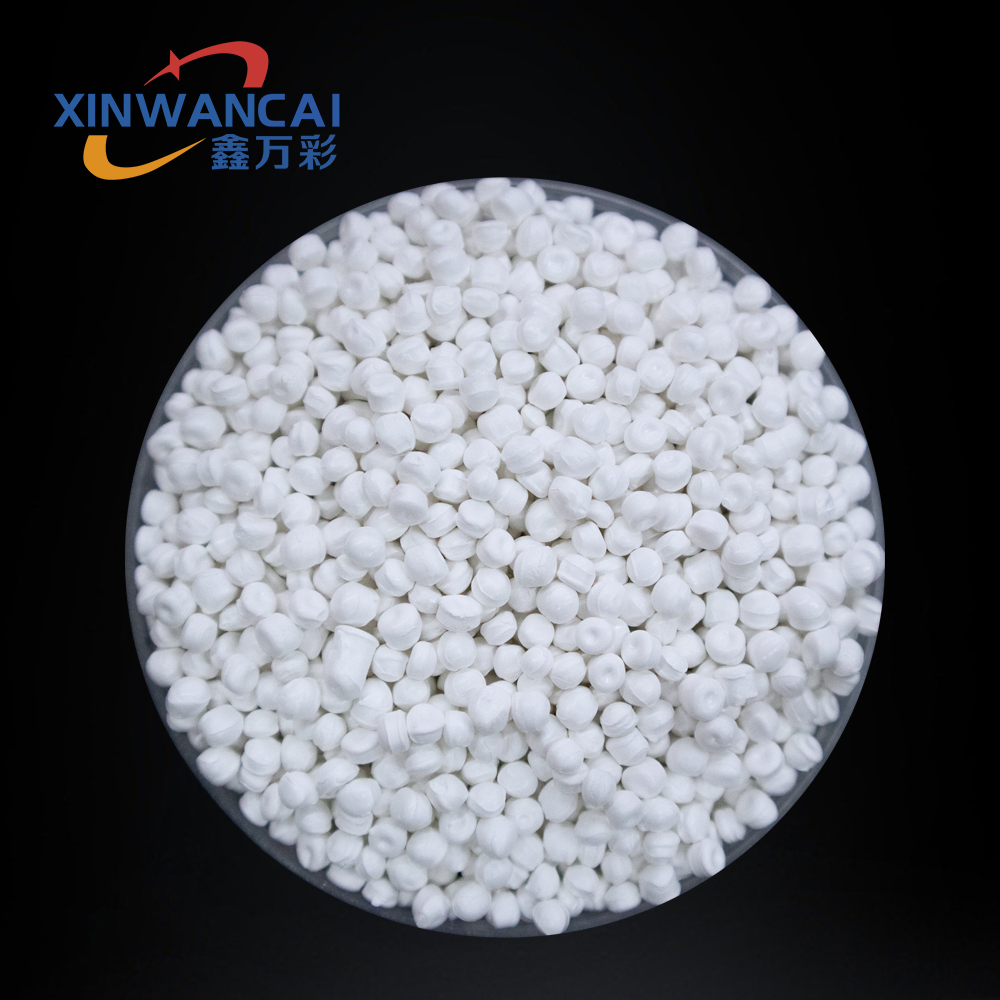
High Titanium White Masterbatch Manufacturer for Superior Opacity and Color Performance
2026-09-07
Every plastic product fights a silent battle against light—white masterbatch is the shield that decides whether colors stay vivid or fade into disappointment. Yet not all titanium dioxide concentrates are created equal, and the gap between 'good enough' and truly superior opacity can make or break your final product. Xinwancai, a high titanium white masterbatch manufacturer, has built its reputation on closing that gap with formulations engineered for exceptional hiding power and color consistency. So what separates their masterbatch from the countless alternatives on the market? The answer lies in a blend of raw material precision and process discipline that few producers are willing to match.
White Masterbatch Opacity Starts With Dispersion, Not Just TiO2 Loading
The assumption that adding more TiO2 automatically yields a whiter film or molded part falls apart quickly in practice. Beyond a certain loading, titanium dioxide particles begin to crowd one another and form aggregates that behave more like oversized filler than efficient light scatterers. Poor dispersion can turn a high-loading masterbatch into an expensive, chalky mess with no meaningful gain in opacity.
What actually drives hiding power is the uniform distribution of individual TiO2 crystals throughout the polymer matrix. When dispersion is done well, each particle contributes to light scattering across its entire surface, and the refractive index difference between the pigment and the surrounding resin is fully exploited. Agglomerates, by contrast, reduce the total pigment-resin interface area and let light slip through untreated zones, leaving a translucent or uneven appearance even at elevated TiO2 levels.
In practical compounding, this means investing in wetting agents and carrier systems that break apart TiO2 agglomerates before they stabilize, and matching screw design and residence time to the specific grade of pigment. Simply raising TiO2 content often worsens dispersion because the increased particle collision frequency in the melt makes re-agglomeration more likely. The better route is to maximize the optical work of the TiO2 already present, then add more only if the process can still maintain a clean, homogeneous melt.
How to Evaluate Loading Claims Without Getting Misled
Manufacturers love to slap a bold load rating on a spec sheet, but that number rarely tells you how the product will hold up on a Tuesday afternoon with uneven weight distribution. Push past the headline figure and look for the test setup: Was the load applied gradually or dropped? Was it centered or offset? These details matter more than the rating itself because they reveal whether the claim reflects a controlled lab scenario or something closer to real use.
Another trick is the missing safety factor. A beam that fails at 10,000 pounds can be marketed with a "working load limit" of 3,000 pounds, which sounds reassuring until you realize the margin is based on assumptions that may not match your job site. Ask for the failure point, not just the recommended limit, and check if the rating assumes brand-new material, perfect welds, or zero vibration. If the supplier can't tell you what happens beyond the rated value, treat that silence as a warning.
Finally, compare claims across sources that have no stake in the sale. Independent test reports, user reviews from rough environments, and repair records often expose gaps between brochure language and day-to-day performance. If a loading claim disappears under slightly different conditions—like moisture, repeated cycles, or a non-level surface—then the product isn't meeting the claim; it's just surviving the one scenario that was tested.
Color Stability Under Real Processing Heat—What to Expect
Real processing heat rarely behaves like a clean, steady ramp in a lab oven. Injection molding barrels, hot runners, and shear from screw recovery can push melt temperatures well past your set points, sometimes by 20°C or more. If your colorant only survives a textbook heat history, expect surprises on the floor—streaks, shift, or outright burn marks near the gate.
What matters is not the single peak temperature, but cumulative exposure. A pigment that endures 280°C for two minutes in a capillary test may still fail after forty-five seconds of high-shear melt residency in a hot runner manifold. Watch for color drift across a run, especially after short stoppages or when cycle times stretch. Those are the moments when heat stability stops being a datasheet claim and becomes a process variable you can actually see.
If you want predictable color, test under your own worst-case conditions—recycled regrind, high back pressure, extended nozzle contact. And don't assume a universal masterbatch will behave the same in polypropylene as it does in nylon. Resin chemistry, antioxidant packages, and moisture all tilt the heat-stability equation. The goal is not perfect lab numbers, but a color that survives your real processing window without leaning on extra purge cycles or prayer.
Thin-Gauge Coverage Without the Opacity Trade-Off
Achieving strong hiding power in a thin film usually means loading up on pigment, which often leads to a chalky surface, poor flow, or a brittle finish. Breaking that link takes a different route: instead of forcing more particles into the wet layer, formulators manipulate how those particles arrange themselves as the coating dries. By controlling the spatial distribution of high-refractive-index pigments through tailored dispersants and controlled flocculation, a low film thickness can still scatter enough light to mask the substrate. The result is a slim profile that behaves like a much thicker coat, without the usual stiffness or loss of gloss.
The real shift comes from treating opacity as a structural property rather than a concentration problem. Traditional approaches treat pigment loading as the only lever, but that assumption breaks down below a certain film weight. When the binder system is engineered to prevent pigment crowding and preserve particle separation, each scattering event becomes more efficient. Additives that limit re-agglomeration during drying keep the effective scattering cross-section high even as the film shrinks. In practice, this allows a 20-micron wet film to deliver hiding comparable to a 35-micron conventional system, with no increase in raw material cost per square meter.
That efficiency opens up formulations that were previously off-limits: ultra-thin coil coatings, flexible packaging inks, or low-VOC architectural finishes that still pass one-coat hide tests. Because the approach works with existing pigment grades, it avoids the steep learning curve of new particle technologies. Instead of chasing ever-finer grind sizes or exotic core-shell pigments, the focus stays on how the wet film transitions to a dry one. It is a quieter kind of innovation—one that shows up as a smoother application, better wet adhesion, and a lower overall film build, without making the user choose between coverage and mechanical integrity.
Undertone Control in White Masterbatch—The Overlooked Variable
Ask a room of plastics processors about white masterbatch and you'll hear plenty about opacity, loading levels, and dispersion quality. But mention undertone—the subtle shift toward yellow or blue that sits beneath the surface of a "white" part—and the conversation often stalls. That's because undertone is rarely specified on a technical data sheet, yet it quietly determines whether a finished product looks clean and crisp or slightly off, especially when viewed next to a competitor's sample under retail lighting.
The root of undertone lies in the pigment package. Titanium dioxide grades differ in their hue contribution, but the real culprit is usually the carrier resin, processing aids, or even trace amounts of metal soaps left over from polymerization. Over multiple heat histories, these components can degrade just enough to introduce a faint yellow cast that becomes obvious in thin sections or clear overmolding. What's worse, adjusting concentration to fix opacity often makes undertone more noticeable, not less.
A practical approach is to set an internal undertone specification using a simple visual comparator or a low-cost spectrophotometer before approving any new lot. Keep a set of molded plaques from the current approved material, and compare every incoming batch against them under both daylight and fluorescent lighting. Small shifts that don't affect opacity can still shift perceived quality, and catching them early avoids compounding waste downstream.
Batch-to-Batch Uniformity You Can Measure, Not Just Assume
Instead of relying on broad assurances, we quantify batch-to-batch consistency through a defined set of physical and chemical fingerprints. Every production lot is tested against reference standards for particle size distribution, moisture content, and spectral signature, giving you a side-by-side view of how closely each new batch tracks the last.
This measurement-first approach turns uniformity into a visible trend line rather than a spoken promise. The data is compiled into a lot-specific uniformity report, so you can spot even minor drift before it affects downstream performance. No guesswork, no hidden variability—just a clear record of what was made and how it compares.
When sourcing materials at scale, that level of transparency changes the conversation. You stop asking whether the next shipment will behave like the previous one and start planning around a dependable, documented baseline.
FAQ
The main difference is pigment loading and dispersion quality. A high titanium dioxide formula typically contains 60-80% TiO2 by weight, which means lower addition rates during extrusion or molding. The better ones also use carrier resins matched to the target polymer, so the white enters the melt quickly without forming agglomerates or fisheyes.
Not always with a single grade. While many carriers are polyolefin-based for PP and PE, engineering resins like ABS, PC, or PA often need a dedicated carrier to prevent degradation or delamination. Reputable manufacturers offer different carrier options or custom-compound the batch on request.
A lot of it hinges on how the TiO2 is pre-dispersed and how tightly the manufacturer controls particle size distribution. If the masterbatch supplier sources the same pigment grade, uses closed-loop dosing, and runs strict melt filtration, the delta E between lots can stay below 0.5. That kind of consistency matters when producing brand-colored caps or appliance panels.
Not if the masterbatch is properly compounded. The TiO2 crystals themselves can be abrasive, but a good formulation includes internal lubricants or waxes that lower friction and improve throughput. Some grades are designed specifically for high-speed film lines where torque buildup would otherwise be a problem.
It depends on base resin and film thickness, but with a 60% TiO2 masterbatch used at 3-5% letdown, many converters see a 20-30% improvement in opacity compared to lower-loading concentrates. In 50-micron PE film, for example, you can often push light transmission below 8% without raising haze too much.
Yes, many manufacturers produce grades that meet FDA, EU 10/2011, and China GB standards for food packaging. The key is to ask whether the carrier resin and all additives are included in the compliance statement, not just the TiO2 pigment itself.
Most high-performance white masterbatches use rutile because it has higher refractive index and better UV stability. If a customer insists on anatase for cost reasons, we usually warn about yellowing and lower brightness, then offer a blended grade with optical brighteners to compensate for the bluish undertone.
Beyond a certificate of analysis, ask for melt flow index compatibility, filter pressure value test results, and oven aging data. Also request a trial run on your own equipment. Those steps reveal whether the masterbatch will process smoothly and hold up in the final application better than any datasheet alone.
Conclusion
Real opacity in white masterbatch rarely comes from simply pushing titanium dioxide percentages higher. It begins with dispersion—how evenly the pigment separates and distributes within the carrier resin. A manufacturer that invests in twin-screw compounding and precise temperature control gets more hiding power per unit of TiO2, which means you are not paying for agglomerates that only look good on a data sheet. When someone quotes a 70% or 80% loading, ask for blown film trials and microscope images, not just the invoice. High titanium white masterbatch must also survive your actual processing heat. Polyethylene and polypropylene degrade under extended barrel residence times, shifting from bright white to a tired yellow. The right stabilization package keeps color stable, so your finished film or sheet looks the same at the die as it did in the hopper.
Thin-gauge coverage is another place where quality separates from hype. High-load masterbatch can cause melt fracture or pinholes if the carrier resin is poorly matched, but a well-designed formula lets you down-gauge without sacrificing opacity. Undertone control matters more than many processors admit: a slightly blue white reads cleaner and brighter, while a yellow undertone makes even high-TiO2 films look dull under retail lighting. A serious manufacturer measures undertone with a spectrophotometer and adjusts each batch to a tight tolerance. That same discipline shows up in batch-to-batch uniformity—melt flow, ash content, and L*, a*, b* values should vary within a narrow window, not drift from lot to lot. When these variables stay controlled, the result is superior opacity and color performance that holds up in real production, not just in a brochure.
Contact Us
Contact Person: JACK
Email: [email protected]
Tel/WhatsApp: 86 18650130917
Website: https://www.xinwancai.com/