

OEM Miniature Circuit Breaker Selection Guide for Industrial Applications
2026-08-27
Choosing an OEM miniature circuit breaker often feels like navigating a maze of trip curves, breaking capacities, and regional standards. One wrong assumption—say, confusing a C-curve with a D-curve—can lead to nuisance tripping or, worse, unprotected equipment. That’s why we’ve put together a practical selection guide rooted in actual industrial applications, not just datasheet theory. From motor inrush currents to panel space constraints, we’ll walk through the details that matter when your design ships to customers. As an OEM supplier, ETEK has seen these trade-offs firsthand and is sharing field-tested insights to help you specify with confidence.
Reading Trip Curves for Motors, Heaters, and Power Supplies
Motor circuit breakers and fuses are often selected with trip curves that can tolerate the 6–10 times full-load current inrush that lasts for a few cycles or even seconds on high-inertia loads. A typical motor curve shows a long-time thermal region for running overloads and a magnetic or instantaneous region set high enough to avoid nuisance tripping during start-up. Reading these curves means checking that the expected starting current and duration sit to the left of the device's curve.
Heaters, being mostly resistive with minimal inrush, need tighter overcurrent protection because their wiring and elements can be damaged quickly by sustained overloads. Their trip curves usually have lower instantaneous pickup and shorter time delays compared with motor circuits, reflecting the fact that a heater should not ride through a fault the way a motor might.
Power supplies bring their own quirks: the input capacitors can draw a large but very brief charging current, while overload behavior may include current limiting or foldback. A protection device for a power supply must avoid tripping on that inrush yet still clear a true short circuit, so time-current curves often need to be compared against both the power supply's inrush energy and its thermal damage limits. In practice, you line up the load's damage curve with the protective device's trip curve and confirm there is enough margin for normal start-up transients.
The Hidden Impact of Enclosure Temperature on Breaker Ratings
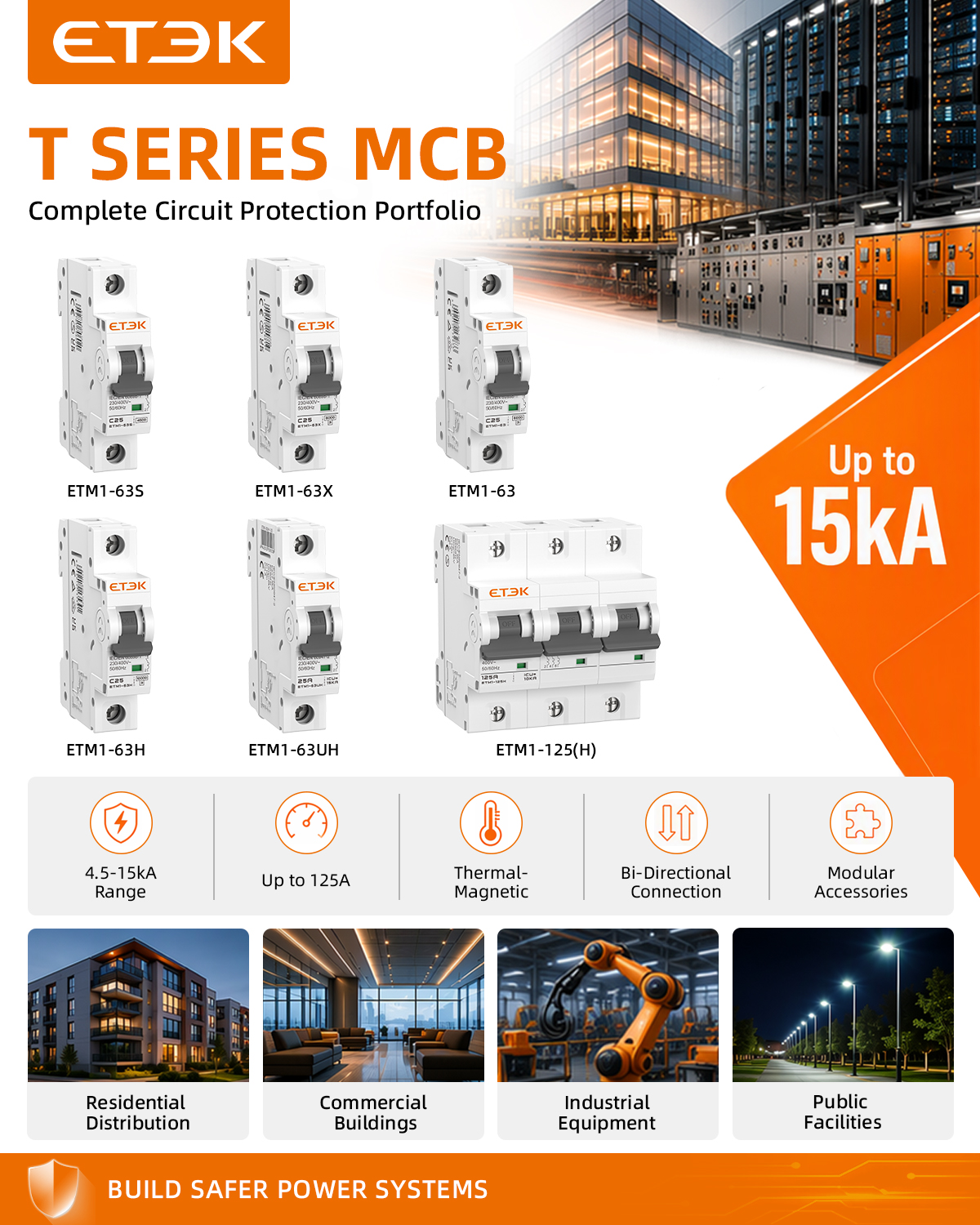
Most selection guides focus on nameplate current ratings and short-circuit interrupting capacity, but the environment where a breaker actually lives often tells a different story. Inside an enclosure, especially one packed with drives, power supplies, or tightly bundled conductors, temperatures routinely climb well above the ambient outside the cabinet. A breaker’s thermal trip element—typically a bimetallic strip—responds to the total heat around it, not just the heat generated by load current. When the surrounding air is already warm, the strip needs far less current to reach its deflection threshold. That means a breaker rated for 20 amps at 40°C might start nuisance-tripping at 16 or 17 amps simply because the enclosure interior sits at 55°C.
The effect becomes more pronounced with molded-case and miniature breakers that rely on thermal-magnetic mechanisms. Manufacturers publish derating curves, but those curves assume a uniform ambient temperature across the entire device. In reality, temperature stratification inside a cabinet creates hot spots near the top or adjacent to heat-generating components. A breaker mounted directly above a variable frequency drive or a bank of resistors may experience local temperatures significantly higher than the average enclosure reading. Even electronic trip units, which use current sensors and microprocessors instead of bimetallic strips, can drift or degrade if their internal components exceed specified operating ranges.
Engineers who ignore this hidden thermal derating often face two opposite problems: either breakers trip too early, causing unexplained downtime, or they fail to trip when expected because the thermal element has already been pre-loaded. Some designs include ambient compensation, but not all models offer it, and the compensation may only cover a narrow band. A practical approach is to measure actual temperatures at the intended mounting locations during commissioning, then apply a realistic derating factor rather than relying on the breaker’s laboratory-tested rating. That small field measurement can prevent both nuisance interruptions and dangerous overload conditions that go undetected.
Selecting the Right Breaking Capacity for Branch Circuits
Most branch circuit selection stops at the continuous current rating, but that tells you next to nothing about what happens when a bolted fault occurs downstream. In many commercial spaces, the available fault current at a subpanel is far higher than the load calculation implies, because transformer impedance and conductor length both shape the short-circuit level. Install a breaker with too low an interrupting capacity and it may rupture before the trip mechanism ever moves.
The starting point should be the calculated short-circuit current at the line terminals where the breaker will sit, not the running current drawn by the equipment. Compare that figure with the breaker's marked interrupting rating, which is expressed in kiloamperes and is not the same as its continuous current capacity. If a fully rated device is not practical, a listed series-rated combination can sometimes be used, but only when the exact tested pair appears in the manufacturer's data and the local inspector accepts it. A larger frame size does not automatically deliver a higher interrupting rating, so each part number has to be checked against the application.
Compact DIN Rail Mounting Without Sacrificing Service Access
The design team faced a common trade-off: shrink the footprint for tight control cabinets, and you typically push critical components out of reach. This unit takes a different route. The DIN rail clip snaps into place with an audible click, yet the entire front face hinges downward after releasing two captive screws. There's no need to unwire terminals or remove adjacent modules just to reach a fuse or swap a relay.
Field technicians will notice the difference immediately. Terminal blocks sit on a slide-out tray that travels a full 40 mm, giving clear access to wire entries and test points even when modules are stacked side by side. Unlike traditional compact designs that force angled screwdrivers and mirror checks, this layout keeps every connection visible and reachable. The rail engagement mechanism uses a spring-loaded latch rather than a rigid hook, so the module can be tilted out of the row without fighting neighboring units.
Maintenance windows shrink because there's no disassembly cascade. A single module can be serviced while the rest of the rail remains powered and operational. The DIN clip holds firm under vibration thanks to a secondary locking tab, but releases with one finger when access is needed. That balance of secure mounting and effortless swing-out access comes from moving the hinge point to the bottom edge, away from the wiring zone—an approach that keeps the cabinet tidy without burying the parts that need attention.
Navigating UL, IEC, and CCC Marks for Global Machine Builds
Machine builders often assume that passing one safety standard clears them for every market. The reality is messier. UL recognition matters in the United States and Canada, where local inspectors and buyers look for the familiar circled mark. IEC standards, often through the CB Scheme, simplify cross-border acceptance but don't carry the same legal weight everywhere—each country can add national deviations. China's CCC mark, meanwhile, is non-negotiable for a long list of industrial equipment, and you can't legally ship without it.
The biggest trap is treating these marks as interchangeable. UL requires a listed or recognized component approach, with ongoing factory surveillance. IEC-based testing is often voluntary until a specific country or customer demands it, yet many builders still need full test reports to satisfy EU or other regional directives. CCC goes further: mandatory testing in Chinese laboratories, a factory audit by Chinese authorities, and annual follow-up inspections. Even your supply chain matters because key components may need their own CCC or CQC approval.
Start with a matrix of your actual target countries, not a vague global assumption. Bring in a certification partner early, before the design is frozen, because retrofitting for different creepage distances, warning labels, or enclosure ratings is expensive. Keep a clean technical file with all test data, drawings, and component certificates. For CCC especially, partner with a local agent or lab that understands the latest catalog updates—China's list changes more often than many builders expect.
When Smart Breakers Outperform Standard Protection in OEM Panels
Standard thermal-magnetic breakers rely on fixed trip curves that cannot adapt to the way an OEM panel actually operates. If the panel feeds a mix of VFDs, soft starters, and single-phase controls, inrush currents and harmonic content can push a conventional breaker into nuisance tripping—or, worse, leave a marginal fault unnoticed until damage occurs. Smart breakers change that by measuring current in real time, logging event waveforms, and allowing trip thresholds or delay bands to be adjusted via software. In applications where load profiles shift between commissioning and full production, that flexibility means the protection can be tuned to the real electrical signature of the machine rather than a one-size-fits-all assumption.
Smart breakers also earn their place when the panel is part of a larger automated system. Communication over Modbus, EtherNet/IP, or Profinet lets operators see per-branch loading, energy consumption, and historical trip data from a central HMI or PLC. That visibility becomes critical for remotely installed OEM skids or process-critical lines where an unexpected shutdown is far more expensive than the cost difference between a standard breaker and a smart one. Instead of sending a technician to inspect a tripped branch, the control system can flag a breaker that is running at 92% of its rated current, predict when it may trip under a known cyclic load, and trigger maintenance during a planned window. In short, smart breakers outperform standard protection when the panel's value depends on uptime, data, and the ability to respond before a fault stops production.
FAQ
Focus first on the available fault current at the point of installation and match the breaker's interrupting rating to that level. Then confirm the voltage rating, number of poles, and whether the trip curve suits the connected load. For control panels with mixed loads, a C curve often handles moderate inrush, but motors or transformers may need a D curve. Also check ambient temperature derating and the physical mounting style before committing.
Trip curves determine how quickly the magnetic element reacts to overcurrent. A B curve trips at 3 to 5 times rated current and works for resistive loads or long cable runs. C curves handle 5 to 10 times rated current and suit general control circuits. D curves allow 10 to 20 times rated current before instant tripping, which prevents nuisance trips from motor starting surges or transformer inrush, but they require lower fault loop impedance to ensure fast clearing under short-circuit conditions.
Industrial facilities typically sit close to large distribution transformers, so the prospective short-circuit current at a branch panel can reach 10 kA, 25 kA, or even higher. A breaker with a 6 kA interrupt rating may fail violently under those conditions. Selecting a breaker with a sufficient kA rating, such as 10 kA or 14 kA, ensures the device can safely open and contain the arc without damaging adjacent equipment or the enclosure.
Thermal trip elements respond to heat, not just current. When multiple breakers are mounted side by side in an enclosure or the surrounding air is above 40 degrees Celsius, the breaker may trip below its nominal rating. Manufacturers publish derating curves or correction factors. An OEM should multiply the load current by the appropriate factor and select a breaker that still provides overload protection without nuisance tripping at elevated temperatures.
A supplementary protector under UL 1077 is only suitable for providing additional protection within equipment, never as the primary branch circuit protection. If the machine or panel already has a UL 489 branch circuit breaker or fuses upstream, then a supplementary protector can be used for individual control circuits, PLC power supplies, or heating elements. For standalone OEM equipment connected directly to a facility's power, a branch circuit breaker rated to UL 489 or IEC 60898 is mandatory.
Selectivity means the downstream breaker nearest the fault trips first, leaving upstream breakers closed and unaffected parts of the plant running. To achieve this, compare time-current curves and energy let-through values. A current-limiting MCB can reduce the peak fault current seen by upstream devices, allowing cascading or series-rated combinations. Some manufacturers publish selectivity tables or coordination charts that show which combinations will discriminate under specified fault levels.
Confirm the breaker matches the DIN rail type, typically 35 mm, and that the terminal design accepts the required wire sizes and torque settings. Check whether the breaker has finger-safe terminals and clear labeling for the line and load sides. Leave adequate ventilation space around the breaker per the manufacturer's instructions, especially when densely packed panels cause heat buildup. Also verify that accessory components like auxiliary contacts or shunt trips are compatible with the same breaker frame.
Yes, different markets demand different compliance marks. For North America, look for UL 489 listing and the appropriate interrupting rating. For Europe, check for IEC/EN 60898 compliance and CE marking. Other regions may require CCC for China, EAC for Eurasian customs union, or local equivalents. The breaker's documentation should state the standards it meets and the maximum voltage and short-circuit rating for each certification. Using a breaker without the correct regional approval can lead to customs delays or field rejection.
Conclusion
Selecting an OEM miniature circuit breaker is rarely a one-line decision. Trip curves must be matched to the actual load profile—motors draw inrush currents that standard B-curve breakers may nuisance-trip on, while heaters and power supplies often need faster or slower thermal responses. Enclosure temperature compounds this: a breaker rated at 40°C inside a sealed cabinet can lose meaningful capacity when internal heat rises, pushing a nominally correct amp rating into premature tripping territory. Branch circuit breaking capacity also deserves attention beyond nominal current, especially where short-circuit currents from transformers or large drives exceed typical 6kA or 10kA assumptions. And compact DIN rail mounting should not force a trade-off against service access—designs with side-by-side busbars and clear labeling cut maintenance downtime without adding panel width.
On the compliance side, global machine builders must reconcile UL, IEC, and CCC marks rather than assuming one standard covers all export markets. The differences in approval testing, terminal torque, and environmental expectations can invalidate a panel if ignored. Meanwhile, smart breakers with integrated current monitoring, adjustable trip settings, and communication protocols often outperform standard protection in OEM panels where remote diagnostics, load shedding, or energy metering matter. The practical takeaway is to avoid treating the breaker as an afterthought: combine mechanical constraints, thermal derating, short-circuit withstand, and regional approvals into a single selection workflow, then verify with actual fault and temperature tests. That approach keeps panel footprints small, uptime high, and field surprises low.
Contact Us
Contact Person: Andy
Email: [email protected]
Tel/WhatsApp: +86 13356133008
Website: https://www.etek-china.com/