
OEM Non-woven Geotextile Solutions for Durable Infrastructure Projects
2026-09-05
Durability in infrastructure is rarely about the visible surface—it’s about the non-woven layer working beneath it. That’s where JInseed Geosynthetics Solution comes in: OEM geotextile solutions designed around your project’s exact drainage, separation, and reinforcement demands. In this guide, we unpack how the right non-woven specification prevents costly failures before they start.
When Native Soils Fight Back: Non-Woven Layers That Keep Their Structure
Native soils aren't passive backdrops—they push, swell, and settle with a rhythm all their own. The challenge isn't stopping that movement, but letting it happen without the surface above losing its shape. Non-woven layers answer this by acting less like a rigid wall and more like a tough, flexible net. Their randomly tangled fibers create countless tiny hinges, so the fabric can stretch and give under pressure while still holding the soil particles together. That means a driveway or path stays level through wet-dry cycles and freeze-thaw shifts, because the layer underneath bends with the earth instead of cracking against it.
What sets these layers apart is how they distribute force across a wide area. A single point of stress—say, a tree root pushing upward—doesn't tear through like it might with a solid sheet. Instead, the load travels along the fiber network, spreading the strain until it becomes almost negligible. This lets the soil do what it naturally does: heave a little, settle a little, breathe. Meanwhile, the non-woven fabric keeps the structural integrity intact, preventing potholes, ruts, or base contamination that would otherwise demand constant repair.
In practice, this means fewer callbacks and quieter performance. Installers who choose a non-woven separation layer often notice that the ground no longer dictates the lifespan of the surface. The fabric doesn't fight the native soil; it negotiates with it. And because the material holds its structure without chemical binders or heavy compaction, the whole system stays porous and lightweight—working with the landscape rather than against it.
Sizing the Pores for Your Fines, Not the Industry Average
Chances are, the mesh or membrane you pulled off the shelf was rated for a “typical” powder—some averaged-out blend of particle sizes that rarely matches what actually runs through your line. When your fines skew finer or clump more than that imaginary baseline, those industry-standard openings either let too much through or choke on the very material they’re supposed to classify. The result isn’t just a slight inefficiency; it’s a steady bleed of yield, a filter that blinds halfway through a shift, or a product that fails spec without an obvious culprit.
Instead of trusting a generic pore size, start with the actual size distribution of your fines—not the vendor’s datasheet, but a sample taken under your own operating conditions. Then consider how those particles behave when they’re wet, dry, vibrated, or compressed. A powder that flows freely in a lab may bridge across openings on a production screener, while a slightly cohesive fine might need a pore only 15% larger than the median particle to avoid blinding. The sweet spot rarely lands on a round number or a standard series; it comes from testing a few candidate openings against your real material and watching both throughput and retention over time.
Once you’ve dialed in pores that match your fines rather than the industry’s guess, the downstream effects show up quickly. Less energy spent unblinding screens, fewer rejected batches from oversize contamination, and longer intervals between filter changeouts. You might even find that a seemingly “oversized” pore actually improves separation because it lets the fines pass without forcing them into a cake that traps coarser particles. That’s the difference between sizing for a category and sizing for the powder in your hand.
Why Roll Widths Should Follow Your Paver, Not the Other Way Around
When a paver lays down a mat at a given width, the compaction equipment behind it needs to match that width in a way that supports consistent density. If your roller drums are wider than the paved pass, you end up running the drum edge over the cold longitudinal joint or onto the adjacent lane, which can crush the unsupported edge or create a ridge. Narrower drums, on the other hand, force you to make multiple overlapping passes that cool unevenly and leave stripes.
Matching the roller width to the paver isn't about buying a new machine for every job; it's about planning the rolling pattern from the screed width backward. On most highway-class pavers laying 10 to 12 feet, a 66-inch or 78-inch drum can cover the mat in two side-by-side passes with just enough overlap to hit the center without lingering on the cold joint. That keeps the breakdown pass right in the temperature window and avoids wandering onto a lane that's already compacted or still raw.
Some crews try to let the roller dictate the paving width, narrowing the paver or shifting the screed extension to suit the drums they already own. That usually means more longitudinal joints, more handwork at the edges, and a rougher ride over time. It's easier to adjust the rolling pattern, add a smaller breakdown roller, or change the pass sequence than to compromise the mat geometry just to fit the compactor.
The Case for Custom Mass Per Unit Area in High-Cycle Load Paths
Uniform mass per unit area often looks like a safe default until fatigue data from long-duration testing tells a different story. In high-cycle load paths, stress amplitudes can vary by an order of magnitude across a single plate or shell, yet a constant areal density forces every region to carry the same material weight. That means low-stress zones become parasitic mass, while critical fillets or hole edges may still be underbuilt because the global thickness was set for an average condition. By shifting to a custom distribution, the material is placed where crack initiation actually competes with endurance limits, not where geometric convenience dictates.
This approach is not simply about thinning non-critical areas. It requires mapping the principal stress trajectories and the local mean stress sensitivity over the expected cycle count. Once that map exists, mass per unit area can be graded in steps or continuously, so that the component's fatigue damage accumulation stays more uniform. The result is often a reduction in total areal weight without sacrificing life, or conversely, an extension in cycles to failure at the same weight. For parts that see millions of load reversals, that trade-off moves from marginal to decisive.
Skeptics point to manufacturing complexity, but modern processes such as tailored fiber placement, variable-thickness rolling, or additive deposition already allow spatial control of areal density at production scale. The real bottleneck is the design workflow: accepting that high-cycle fatigue is a local phenomenon, not a coupon-level average. Once engineering teams treat mass per unit area as a field variable rather than a fixed parameter, the case for custom gradients in load paths becomes difficult to ignore.
Chemical and UV Exposure: Matching Polymer Blends to Site Conditions
Selecting a polymer blend without accounting for the actual chemical environment and UV load at a site often leads to premature cracking, discoloration, or loss of mechanical strength. A storage tank near a coastal industrial zone, for instance, faces salt spray, hydrocarbon vapors, and intense sunlight simultaneously. In that context, a blend that resists oxidation but degrades under UV is just as unsuitable as one with high UV stability but poor solvent resistance. The first step is mapping exposure: identify whether contact is intermittent splash or continuous immersion, whether chemicals are oxidizing, acidic, or aromatic, and whether the site receives prolonged direct sunlight or only diffuse daylight.
Blend selection then becomes a balancing act. For acidic or bleach-heavy environments, PVC blended with chlorinated polyethylene (CPE) offers both chemical inertness and improved weatherability over unmodified PVC. Where aromatic solvents and UV coexist, an ASA/PC blend often outperforms standard ABS because the acrylic ester shell resists yellowing while the polycarbonate core maintains impact strength. Outdoor electrical enclosures exposed to ozone and UV benefit from EPDM-modified polypropylene, which tolerates polar chemicals without the surface chalking seen in some styrenic blends. Each formulation trades a little processability or cost for a specific resistance profile, so matching the blend to the dominant stressor matters more than chasing a single “all-purpose” grade.
Validation should not end at datasheets. Running parallel exposure trials under the site’s actual chemical concentration and UV spectrum reveals failures that accelerated lab tests miss, such as synergistic attack where a mild solvent swells the surface and lets UV penetrate deeper. Adjusting blend ratio, stabilizer package, or even switching to a co-continuous morphology can shift long-term performance more than changing base resins. Field-aged samples from similar installations provide the most reliable guide, but only when the exposure conditions—not just the application—are genuinely comparable.
From Subgrade to Slope: One OEM Source for Multiple Infrastructure Layers
Instead of juggling separate suppliers for base reinforcement, subgrade stabilization, and slope protection, a single OEM can supply geogrids, geotextiles, erosion control blankets, and drainage composites that share design language and testing data. This cuts down on compatibility guesswork when you move from the flat run of a road to a steep embankment.
That continuity matters most at the transitions, where a reinforced slope meets a stabilized subgrade and water tries to find the weak seam. Working with one manufacturer means the tensile properties, aperture sizes, and installation tolerances are documented against the same quality system, so site crews aren't trying to reconcile conflicting specs from three vendors.
It also changes how you plan. You can phase deliveries for the subgrade, then the slope facing, then the drainage layer without redoing submittals or chasing down material certifications. The result is less downtime between layers and fewer finger-pointing moments when something doesn't line up.
FAQ
It means the geotextile is manufactured to your specifications—fiber type, weight, roll size, even core diameter—and then labeled or packaged under your brand. This keeps inventory simpler on large jobs because you receive rolls that fit your equipment and site layout exactly, without needing to repackage on site.
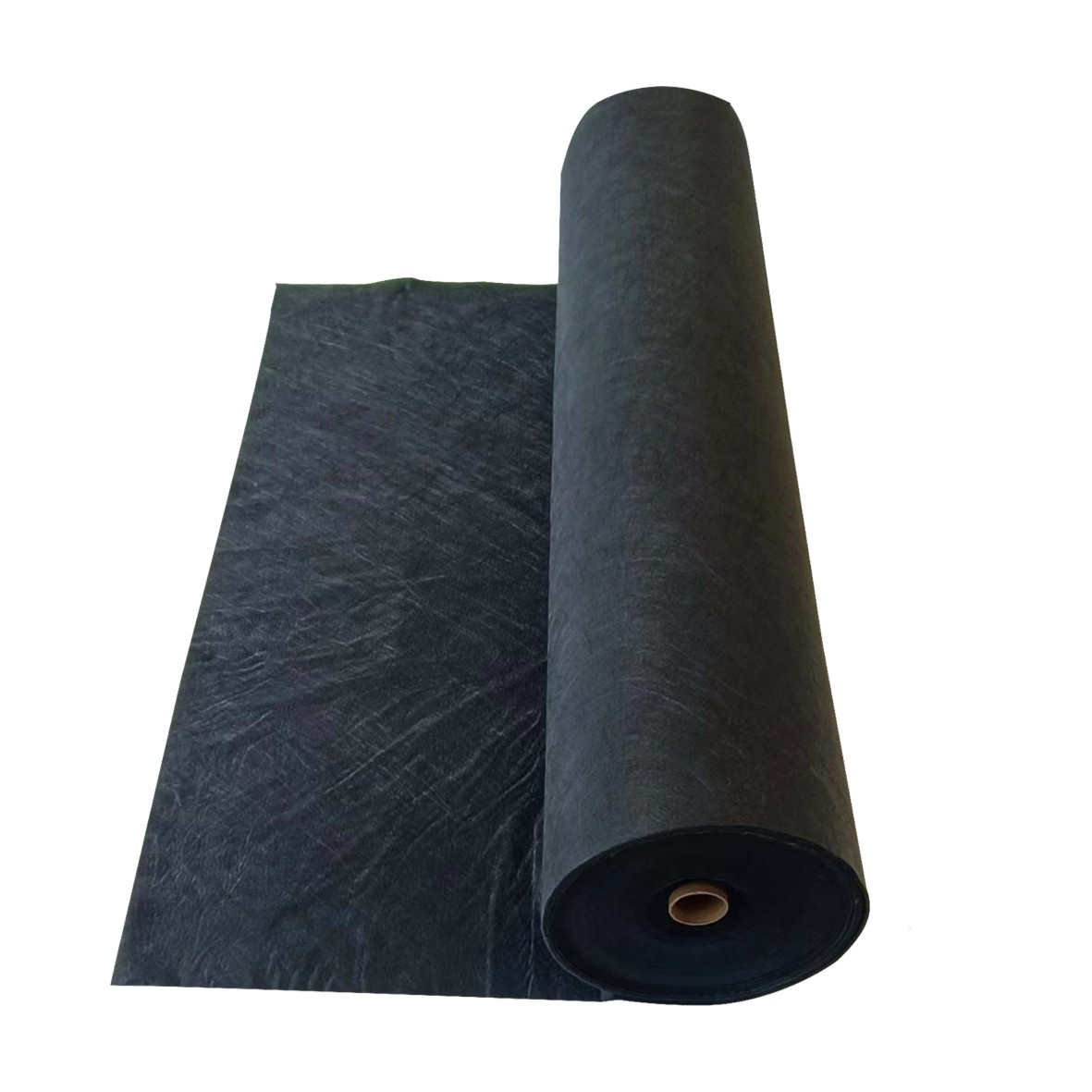
Road subgrades, rail ballast separation, landfill drainage layers, and erosion control behind retaining walls are the big ones. The needle-punched structure excels wherever you need water to pass through while keeping fine soil particles from migrating, which prevents pumping failures under repeated traffic loads.
Woven fabrics are stronger in tension but have limited openings that can clog with fine silts. Non-woven geotextiles, especially those with a high loft, allow lateral water flow within the fabric plane, so they act as both filter and drain. That's why they're preferred behind retaining walls and under permeable pavement.
Yes, typical widths range from 2 to 6 meters and lengths from 50 to 200 meters, but we can cut to your exact dimensions. For highway work, wider rolls mean fewer overlaps and less waste, and we can provide pre-marked overlap lines if that speeds up your crew's installation.
Each production lot is tested for mass per unit area, tensile strength, CBR puncture resistance, and apparent opening size. We also run a water permeability test under a 50 mm head, and if UV exposure during storage is a concern, we can include a UV stabilizer package and provide accelerated weathering data.
When properly installed and covered from direct sunlight, a polypropylene or polyester non-woven geotextile can function for 50 years or more. The main threats are installation damage, not material decay, so using the right puncture resistance for your aggregate size matters more than the polymer itself.
We can produce geotextiles with up to 70% post-industrial recycled polyester without sacrificing strength, which helps with LEED or similar credits. Fully biodegradable natural-fiber versions exist for temporary erosion control, but for permanent infrastructure you'll want the synthetic durability, and we can document the recycled content chain of custody.
The two biggest are leaving the fabric exposed to sunlight for weeks before covering, and using sharp, angular backfill that punctures it during placement. We recommend covering within 14 days, using a 150–300 mm lift of clean sand or rounded gravel directly on the fabric, and avoiding traffic directly on the geotextile before cover.
Conclusion
Off-the-shelf geotextiles rarely survive the moment native soils begin to heave, swell, or channel water where it is not wanted. A non-woven layer that holds its internal structure under those stresses is not a generic filter fabric; it is an engineered response to local ground behavior. That starts with opening sizes matched to the fines in your project, not a midpoint borrowed from some industry chart. If the pores are too large, particles migrate and the layer loses its separating function. If too small, water backs up and pressure builds under the pavement. The same principle applies to roll width: logistics should bend to the paver, not the other way around. A roll that fits the machine width means fewer seams, fewer overlaps, and a faster, cleaner installation with less waste.
Durability also depends on how much fabric you actually place in high-cycle load paths. A one-size-fits-all mass per unit area often leaves thin spots where repeated axle loads grind the layer against angular subbase. Custom grammage lets you reinforce exactly those zones without overbuilding elsewhere. Then there is the chemical and UV side: polymer blends have to match the site, whether it is acidic runoff, alkaline soils, or long sun exposure before covering. Finally, keeping all these variables under one OEM source from subgrade stabilization to slope drainage removes the usual guesswork when mixing suppliers. The result is a geotextile system that behaves like it was designed for your project because, in fact, it was.
Contact Us
Contact Person: Jerry Qiu
Email: [email protected]
Tel/WhatsApp: +65 84265294
Website: https://www.jinseed-geo.com