

OEM Powder Metallurgy Parts That Improve Strength and Reduce Manufacturing Costs
2026-11-21
Powder metallurgy has quietly moved from a niche process to a strategic advantage for OEMs that need stronger parts without inflating production budgets. If your current manufacturing route forces you to choose between mechanical performance and cost control, it may be time to look again. At XIAYI, we help product teams replace machining-heavy designs with near-net-shape powder metal components that hold tighter tolerances, reduce material waste, and often outperform their wrought counterparts in fatigue and wear resistance. In this post, we’ll unpack how the right powder metallurgy approach can improve part strength while cutting total manufacturing costs — and why more engineers are making the switch earlier in the design cycle.
What Makes OEM Powder Metallurgy Parts Stronger Than Their Machined Counterparts
The strength advantage starts with how the metal is handled before it ever becomes a finished part. Machining carves away solid stock, which means the final component inherits whatever internal flaws, voids, or directional grain weaknesses were already present in the raw bar or billet. Powder metallurgy bypasses that entirely. Fine metal powders are compacted under enormous pressure and then sintered at temperatures just below melting point, causing the particles to bond at the atomic level. The result is a part with a uniform microstructure and a density that can be tailored to the load path, something a machined part simply cannot offer without extensive and costly secondary processing.
Another factor is material efficiency and alloy flexibility. When you machine a part, you are limited to commercially available alloys in standard shapes, and you waste a significant fraction of the material as chips. Powder metallurgy allows formulators to blend elemental powders that would be impractical or impossible to cast or machine as a single alloy, such as certain copper-infiltrated steels or self-lubricating compositions. These custom blends can be optimized for fatigue resistance, impact toughness, or wear performance, giving OEM parts a strength envelope that extends beyond conventional wrought or cast equivalents.
Finally, the near-net-shape nature of powder metallurgy reduces the number of stress risers introduced by subtractive processes. Sharp tool marks, abrupt changes in section from over-machining, and heat-affected zones from aggressive cutting all act as initiation points for cracks. A well-designed powder metal part transitions smoothly between thicknesses and retains a uniform surface condition from compaction, which helps distribute stress more evenly. This is why highly loaded components like synchronizer hubs, planetary carriers, and oil pump gears often perform better when produced through powder metallurgy rather than being hogged out of solid stock.
Lower Manufacturing Costs Start With Net-Shape Compaction and Fewer Secondary Steps
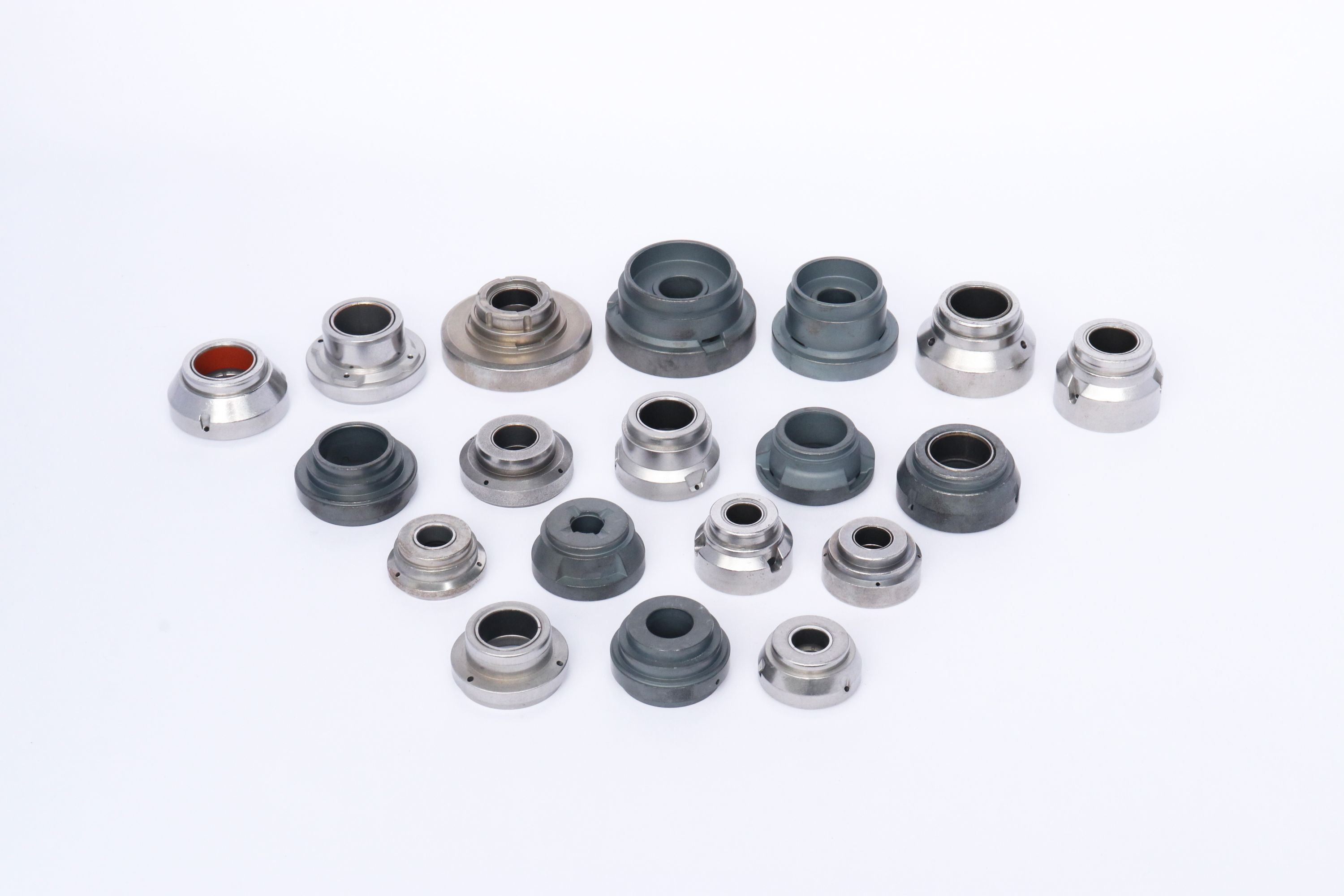
Cost reduction in powder metal manufacturing rarely comes from a single dramatic change. More often, it starts with how closely a compacted part can match its final shape before any machining happens. Net-shape compaction pushes material into geometry that already includes holes, undercuts, and surface details, which means downstream operations become far less invasive. Instead of milling away large volumes of stock, shops only need light finishing passes or simple deburring. That shift alone trims cycle time, tool wear, and the number of workstations a part must travel through.
Fewer secondary steps also reduce the hidden costs that traditional machining tends to carry. Every extra operation adds setup labor, inspection points, scrap risk, and the chance of a dimensional drift slipping through unnoticed. When a compacted blank arrives close to net shape, those variables shrink. The part spends less time in queues between machines, and operators spend less time re-clamping or re-zeroing tools. Over a production run of thousands of units, even a modest reduction in handling can outweigh the initial tooling investment for higher-precision compaction dies.
The practical advantage becomes clearest in complex geometries that would otherwise demand multi-axis milling or EDM. A well-designed compaction process can reproduce internal splines, asymmetric flanges, and tight corner radii straight from the press. While die design and powder selection require upfront engineering attention, they pay back through repeatability. Rather than chasing cost savings by speeding up individual cuts, the smarter route is to eliminate the need for those cuts in the first place.
Alloy Selection and Density Controls That Raise Load-Bearing Capacity
Material choice sets the ceiling for what a component can endure before geometry even enters the picture. Copper-manganese and high-zinc brass families often get overlooked because they cost a bit more up front, yet their cold-worked yield strengths climb quickly without turning brittle. The real difference shows up under repeated compressive pulses, where a denser, finer-grained alloy shrugs off microcracks that would spread through a cheaper leaded variant. Matching the alloy to the actual stress mode—not just the peak load—prevents the kind of premature seating that field inspections tend to blame on poor installation.
Density is not simply a number pulled from a data sheet; it is a result of how the raw powder or billet gets consolidated. Press-and-sinter routes can leave isolated porosity that acts like a hidden notch, trimming load capacity by twenty percent or more even when the bulk composition looks identical. Switching to a wrought or hot-isostatic-pressed feedstock closes those voids and aligns the grain flow with the primary bearing axis. In practice, a modest increase in final density often buys more fatigue life than a fancier alloy grade, because the failure path shifts from internal void growth to surface-initiated wear that can be managed with lubrication.
Small adjustments in secondary processing can amplify both effects. A carefully controlled aging treatment after machining can raise hardness without locking in residual tensile stress at the thread roots or shoulder fillets. Likewise, limiting density variation across a single batch avoids the odd underperforming part that drags down reliability statistics. Rather than chasing a single impressive tensile figure, engineers who weigh alloy chemistry, consolidation method, and stress-relief practice together end up with components that hold rated load long after the test certificate has been filed away.
Scrap Reduction and Setup Time Savings in Press-and-Sinter Production
Powder compaction often leaves a trail of green cracks, edge chipping, and density variation that only becomes visible after sintering. Instead of accepting these losses as fixed, many shops now map scrap back to specific tool movements and fill ratios. Small adjustments to die lubrication or punch timing regularly cut reject rates by double digits without any capital spend.
Setup time is another quiet drain. Traditional changeovers between part numbers can eat half a shift, but magnetic quick-change tooling and preset die stacks bring that down to under an hour. Recording every adjustment during the first run creates a recipe for the next setup, so operators stop relearning the same alignment issues each time a job returns.
When scrap drops and setups shrink, the freed capacity shows up immediately in on-time delivery. One line running three extra hours a week often replaces the need for a second press, turning process discipline into a genuine cost advantage rather than a maintenance slogan.
Where Powder Metal Components Replace Machined Steel in Structural Assemblies
Design teams often discover the strongest case for powder metal when a machined steel bracket, lever, or carrier requires multiple setups and still leaves sharp corners that concentrate stress. A single compaction cycle can produce ribs, bosses, and through-holes in locations that would otherwise demand angled drilling or wire EDM. That freedom changes how structural joints are detailed: instead of welding a separate hub onto a plate, the hub becomes part of the same pressed form, and the assembly loses a failure point while gaining repeatable alignment.
The substitution usually starts with a cost review on parts that begin as bar stock or plate and lose more than forty percent of their mass to chips. Shifting those geometries to a powder metal route keeps the alloy content where it is needed and avoids the scrap handling, coolant maintenance, and tool wear associated with heavy machining. In structural use, the benefit is not only per-piece price. The pressed surface finish and controlled density also create a predictable seating face for bolts, bearings, or mating stampings, which reduces the need for secondary grinding in several high-volume assemblies.
There are limits that experienced manufacturers check early: very long unsupported walls, thin sections that cannot fill consistently, and fatigue loads that require a wrought steel pedigree may still favor machining or forging. But for many brackets, steering column mounts, and lock hardware, powder metal now matches the loads while eliminating the shop-floor bottleneck of machining centers dedicated to families of low-complexity but awkward steel parts.
Heat Treatment and Infiltration Options That Change Part Performance
The way a sintered component responds to load, wear, and fatigue often has less to do with its base chemistry than with what happens after the compact leaves the furnace. Heat treatment can shift hardness profiles, refine grain structure, or introduce controlled case depths that plain sintering cannot achieve. Meanwhile, infiltration with copper or bronze fills interconnected porosity to create a denser, more pressure-tight part with better machinability and impact resistance. The choice between these routes is rarely obvious because each one changes not just a single property but a whole balance of strength, ductility, and dimensional stability.
When a design calls for a hard surface over a tough core, processes like carbonitriding or induction hardening offer a practical compromise. These methods push carbon or nitrogen into the outer layer while leaving the interior relatively soft, which helps absorb shock without cracking. Infiltration, on the other hand, works from the inside out. A pressed copper compact placed against the steel part melts during sintering and wicks into the open pores, reducing internal stress concentrators and improving fatigue life. Because infiltration also closes off leak paths, it is often preferred for hydraulic or pneumatic fittings that must hold pressure without secondary sealing operations.
Selecting the right post-sinter treatment depends on how the part actually fails in service. If wear or surface scoring is the main problem, a heat treatment that raises surface hardness may be enough. If porosity is causing low tensile strength or fluid leakage, infiltration becomes more attractive. Some manufacturers combine both approaches: infiltrate first to densify the network, then heat treat to bring hardness up to specification. That sequence can unlock performance levels that neither method reaches alone, but it also requires tighter control over time, temperature, and atmosphere to avoid distortion or unwanted carbide formation.
FAQ
Strength gains come mainly from controlled powder formulations, higher compacted density, and post-sinter treatments. Processes like warm compaction, re-pressing, and sinter hardening can raise tensile strength and fatigue resistance to levels close to wrought steel while keeping material costs lower than heavily alloyed alternatives.
Powder metallurgy forms parts close to final shape, so material waste is typically under five percent. Machining from bar stock often removes half or more of the raw material, which drives up cost and lead time. The switch makes sense when the part geometry is complex but can be pressed along one axis.
Gears, cams, sprockets, flanged hubs, and multi-level structural shapes are common. Features like keyways, splines, and bosses can be pressed directly into the part. The main limit is that undercuts and side holes generally require secondary operations, so design coordination matters.
Iron-based systems such as FN-0205, FN-0208, FD-0405, and diffusion-alloyed powders are widely used for load-bearing parts. Copper, nickel, and molybdenum additions improve hardenability, and combining them with sinter hardening or heat treatment produces good hardness and wear resistance without excessive alloy cost.
Higher density means fewer internal pores, which translates directly into better tensile strength, ductility, and fatigue life. Processes like warm compaction, re-pressing, or high-velocity compaction can push sintered density above 7.2 g/cm3, making the part more reliable under dynamic loads.
Large runs usually deliver the strongest payback because tooling costs spread across many pieces. However, mid-volume programs can also work when the design eliminates multiple machining steps or when the required material would be difficult to machine efficiently.
Many parts need deburring, sizing, or light machining on critical faces. Some also receive oil impregnation, steam treatment, or heat treatment to improve wear and corrosion behavior. Well-designed powder metal parts keep these extra steps to a minimum, which helps preserve the overall cost advantage.
Early collaboration with the powder metal supplier is the biggest factor. Keeping the pressing direction simple, avoiding thin walls, adding proper draft angles, and specifying realistic tolerances can eliminate unnecessary secondary work and improve strength consistency throughout the batch.
Conclusion
OEM powder metallurgy parts earn their place in structural assemblies largely because the press-and-sinter route builds strength into the component from the start. Unlike machined steel, where cutting can interrupt grain flow and waste material, net-shape compaction leaves a denser, more uniform cross-section with far less scrap. Alloy selection then becomes a practical lever: copper, nickel, and molybdenum additions raise hardenability and load-bearing capacity without driving up raw material cost. Tighter density controls on the shop floor translate directly into predictable tensile and fatigue performance, so design engineers do not have to over-specify a part just to compensate for inconsistent stock removal.
The cost story is equally direct. Fewer secondary steps—less turning, drilling, deburring, and inspection—cut setup time and let one press operator manage multiple cavities. Where machined steel components once required separate blanks, fixtures, and chip handling, a compacted preform can be sintered, sized, and shipped with only a light secondary operation. Heat treatment and infiltration add a final layer of control: steam treating seals porosity and improves corrosion resistance, while copper infiltration can close pores and raise apparent hardness. These options change how a part behaves under load without changing its net shape, which is why more structural assemblies are replacing machined steel with powder metal parts in brackets, flanges, gears, and housings.
Contact Us
Contact Person: Leela
Email: [email protected]
Tel/WhatsApp: 8613586885132
Website: https://www.xiayishockparts.com