

Wholesale Truss Screeds Manufacturer Guide: Ensuring Superior Concrete Finishing
2026-07-09
Achieving a flawless concrete finish doesn't happen by chance—it starts with the right tools. When you're sourcing truss screeds at scale, the manufacturer you choose can make or break your project's quality. This guide cuts through the noise to show you exactly what separates a premium wholesale partner from the rest. And if you're looking for equipment that consistently delivers superior results, Dynamic has been setting the standard for years.
Core Engineering Advantages of Truss Screeds
The defining strength of a truss screed lies in its triangular framework, which delivers exceptional rigidity without excessive weight. This structural efficiency allows the screed to span wide pours while resisting deflection under heavy concrete loads. Unlike roller or vibrating beam alternatives that can bow across larger slabs, a well-engineered truss design maintains a true strike-off plane, resulting in flatter floors with fewer undulations. The open truss geometry also permits concrete to flow through the screed during the pulling process, reducing material push and making the operation smoother for the crew.
Beyond span capability, truss screeds offer fine-tuning features that directly impact surface quality. Independently adjustable eccentrics or vibrators let operators dial in the exact amplitude and frequency needed for the mix design and slump. Over-vibration is a common pitfall that can bring too much paste to the surface or segregate aggregates, but precise control helps avoid these issues. In addition, the ability to connect multiple truss sections enables handling of unusual geometries—pavement, bridge decks, or long industrial aisles—without compromising the stiffness that keeps the strike-off edge straight.
Durability in these machines translates directly to project reliability. Quality truss screeds are built with welded, not bolted, connections at critical joints to eliminate looseness over time. The marriage of lightweight metals and hardened wear strips on the blade extends service life, even when running against abrasive mixes. This focus on engineering nuances—from the geometry of the crown adjustment to the balance of the entire assembly—means that contractors aren't constantly recalibrating or fighting the tool. Instead, they get consistent results hour after hour, which is what separates a leading truss screed from a commodity screed on a busy jobsite.
Material and Build Quality That Withstands Daily Jobsite Demands
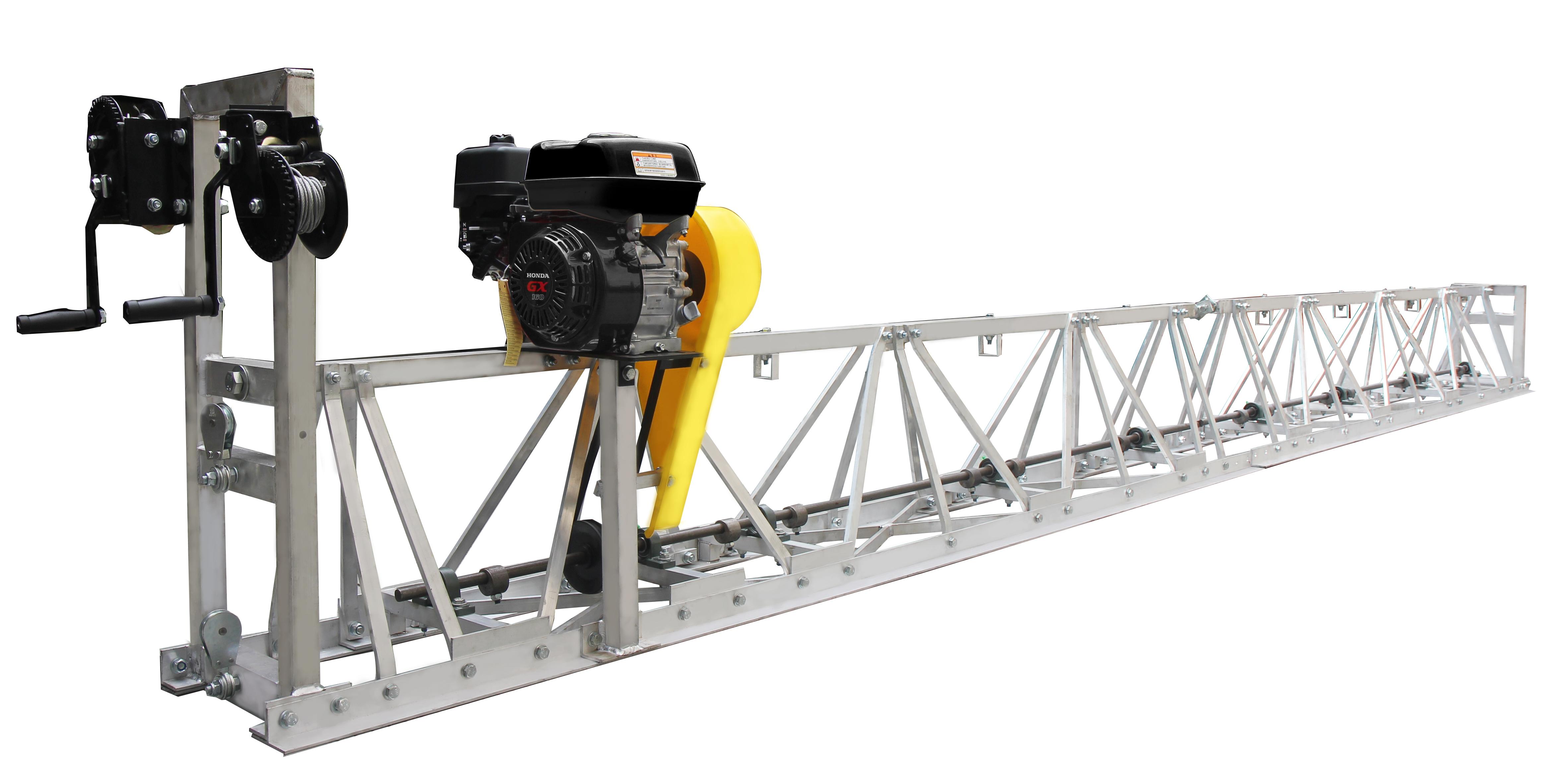
Every piece of gear we produce is built to handle the relentless grind of daily jobsite life. We use high-grade, impact-resistant polymers and aircraft-grade aluminum where it counts, so your tools shrug off drops, bumps, and exposure to debris without missing a beat. Overmolded rubber grips and reinforced stress points aren’t just afterthoughts—they’re deliberate choices that keep your equipment performing when the conditions turn ugly.
Attention to detail sets our build quality apart. Sealed bearings and gasketed joints block out dust and moisture, extending the life of the tool far beyond typical jobsite standards. Machined surfaces mate with precision, eliminating wobble and backlash that can compromise accuracy. Even the finish is selected for function: a textured powder coating resists scratches and reduces glare, while still letting you keep a secure hold in wet or oily conditions.
We don’t just trust our materials—we test them beyond what any rational worksite would demand. Prototypes endure thousands of cycles in abrasive chambers, get dropped from scaffold heights onto concrete, and are exposed to extreme temperature swings. The result is a lineup that makes no excuses: it arrives tight, stays tight, and asks for very little in return, day after punishing day.
Precision Leveling and Vibration Mechanisms Explained
Achieving nanometre-scale accuracy in modern manufacturing depends heavily on how well a system can isolate itself from ground-borne disturbances while maintaining a perfectly flat reference. Precision leveling goes beyond simple bubble-level adjustments—it involves continuous monitoring through high-resolution sensors and real-time actuator corrections that compensate for thermal drift, load shifts, and micro-settling. Vibration mechanisms, on the other hand, tackle a broader spectrum of interference, from building sway and foot traffic to acoustic noise and internal motor cogging.
The core idea behind active leveling is a closed-loop feedback chain. Capacitive or optical sensors detect minute tilt or height variations and feed data to a controller that commands piezoelectric or voice-coil actuators. These actuators push or pull mounting points with sub-micrometre resolution, often at frequencies up to several hundred hertz. Vibration isolation can be passive—using elastomeric pads, air springs, or wire rope isolators that naturally filter high frequencies—but hybrid systems add electromagnetic or servo-driven elements to cancel low-frequency resonance without sacrificing stiffness. The tuning balance between compliance and rigidity becomes critical when instruments must operate in noisy factory environments.
In semiconductor lithography or electron microscopy, even a few nanometres of sway can distort imaging or overlay alignment. Here, leveling and vibration control merge into a single integrated framework: the leveling loop handles quasi-static deformations while the vibration loop actively dampens dynamic transients. For instance, granite or composite polymer bases provide inherent stability, but they still rely on strategically placed actuators and velocity feedback sensors. The result is a workpoint that stays virtually motionless relative to the process chamber, enabling reliable atomic-scale fabrication and measurement across shifts that last days or weeks.
How to Match Screed Specifications to Your Concrete Slab Requirements
Choosing the right screed isn’t just about picking a product off the shelf—it starts with a clear picture of what your slab actually needs to do. Consider the slab’s purpose, its expected load, and the kind of traffic it will face. Is it a residential floor that needs a smooth finish for vinyl, or an industrial space that must handle heavy forklifts? These details directly influence the type of screed you select, from its thickness and strength to its curing time. Without matching these factors, you risk underperformance or premature failure no matter how good the screed appears on paper.
Once the slab’s demands are clear, focus on the screed’s key properties: compressive strength, workability, and bonding method. For example, a bonded screed is ideal for thinner applications where a strong mechanical key is possible, while a floating screed works better over insulation or uneven subfloors. Flow or self-smoothing screeds often save time and achieve high flatness, but they require precise thickness control. Don’t overlook drying time either—some projects can’t afford the weeks it takes for a traditional sand-cement screed, so a fast-drying alternative might be worth the extra cost. Aligning these specs with the slab’s needs prevents delays and ensures the final surface matches expectations.
Finally, real-world conditions matter as much as numbers on a datasheet. Substrate preparation, ambient temperature, and moisture levels can alter how a screed performs, so adjust your specifications accordingly. If the slab will be exposed to thermal movement, a screed with more flexibility or reinforcement might be necessary. Always cross-check that the chosen system is compatible with the slab’s expansion joints and any underfloor services. A careful walkthrough of these practical details keeps your screed choice from becoming a weak link in the floor’s overall performance.
Maintenance and On-Site Handling Best Practices
Regular inspections form the backbone of any robust maintenance plan. Rather than waiting for equipment to fail, set up a schedule that aligns with your operational tempo—daily visual checks for wear and tear, weekly functional tests, and deeper monthly reviews. Keep a simple logbook, digital or physical, to track these checks and any irregularities you spot. This habit not only helps catch minor issues before they become costly repairs but also gives you a clear history of your machine's health over time.
On-site handling requires a clear set of common-sense rules that everyone follows. For instance, always clean tools and surfaces before and after use to prevent contamination, and make sure only trained personnel operate sensitive equipment. When moving parts or assemblies, use the right lifting gear and protect exposed components from dirt and moisture. In case of unexpected breakdowns, have a straightforward troubleshooting guide posted nearby—something that prompts the operator to check power, connections, and common fault indicators before calling for help. This approach reduces downtime and builds confidence among your team.
Comparing Productivity Gains Across Leading Truss Screed Models
Truss screeds have long been the backbone of high-volume concrete placement, but not all models deliver the same jump in daily output. The real differentiator often comes down to how quickly you can set up, pour, and move to the next section. For instance, a lightweight model with tool-free pin connections and rapid winch adjustments can shave 20–30 minutes off each repositioning, which, over a large slab, translates into hundreds of extra square feet finished before the crew calls it a day.
When you dig into the numbers, horsepower and vibration frequency aren't the whole story. Some leading truss screeds pair a high-frequency eccentric shaft with a self-propelled drive system, effectively cutting the pass time in half on low-slump mixes. In side-by-side comparisons, one operator with a ride-on unit consistently outpaced two workers on a manual machine, finishing 40% more square footage per hour. The kicker? That gain wasn't just about raw speed—it came from reduced fatigue and fewer re-passes to hit flatness specs.
Real-world jobsites reveal that productivity gaps widen even further when you factor in maintenance and downtime. Models with sealed bearings, stainless steel rails, and quick-change blade cassettes spend measurably more time on the concrete and less time being wiped down or repaired. Contractors tracking their weekly output often find that a truss screed with these features adds the equivalent of an extra half-day of production each week, simply because it’s not sidelined by seized rollers or bent crown adjustments.
FAQ
A truss screed is a rigid, triangular frame that spans across forms and vibrates while being pulled along the concrete surface. Unlike handheld bull floats or roller screeds, it uses a truss design to stay straight over wide pours without sagging, which gives you a consistently flat slab. The vibration consolidates the concrete and brings paste to the surface, reducing manual labor and improving finish quality.
Length depends on your pour width—add a couple of feet to your widest form spacing so the screed can ride smoothly on the rails. For power, gas engines are common on sites without electricity, but electric motors run quieter and are better indoors. Consider blade type too: reversible blades work well with low-slump mixes, while standard blades handle most residential and commercial flatwork.
Look beyond price—check if they use aircraft-grade aluminum for strength without excessive weight, and whether they offer replaceable wear parts like bearings and eccentric weights. A good manufacturer will provide detailed specs on amplitude and frequency, have a track record with contractors doing similar work, and offer customization for odd widths or special blade configurations.
Clean the unit after every pour—concrete buildup on blades and clamps causes imbalance and rough operation. Lubricate bearings and check bolt tightness weekly. Store it indoors or covered to avoid corrosion on the aluminum and engine components. Replace worn eccentric weights in pairs so vibration stays even; a lopsided screed will leave ripples in the slab.
The truss acts as a straightedge that self-levels across forms, and the vibration settles aggregate just enough to remove high spots without overworking the surface. Paired with laser-controlled winches, you can hold FF numbers above 50 consistently. It eliminates the guesswork of a handheld straightedge and the low spots that come from uneven manual screeding pressure.
One common error is pulling too fast—if the concrete doesn't have time to consolidate, you'll trap air pockets and get a wavy surface. Another is running the screed on dry concrete; it should be used right after strike-off while the mix is still plastic. Also, not matching the vibration frequency to the slump—lower slump needs higher frequency—leads to poor compaction. Training operators to read the concrete and adjust speed and vibration on the fly makes a huge difference.
Yes, but you need hinged or segmented truss sections that let the frame follow a grade. Some manufacturers offer adjustable end carriages with swivel mounts so the screed can tilt. For steep slopes, you might add a winch system to control descent and keep the screed engaged. Discuss your project's cross-slope and drainage requirements with the manufacturer to get the right setup.
Direct purchasing often means you can specify custom lengths, blade styles, and motor options without paying a middleman markup. You also get access to engineering support for special pours—like very low-clearance screeds for topping slabs—and faster replacement part turnaround. Over years of use, the relationship with the factory saves money through bulk pricing and honest advice on what you actually need for your typical jobs.
Conclusion
A reliable wholesale truss screed manufacturer guide highlights how engineering prowess directly translates to flawless concrete finishing. Beyond basic leveling, core advantages like truss frame rigidity minimize flex and deflection across wide pours, while integrated vibration systems compact the mix evenly to eliminate air voids and honeycombing. These mechanisms must work in harmony: properly calibrated oscillation settles the concrete without overworking the surface, ensuring a dense, durable slab. Equally important is the choice of materials—high-grade aluminum alloys and reinforced connections resist corrosion and fatigue from daily jobsite exposure, vibration, and chemical contact. Build quality doesn't just mean surviving harsh conditions; it preserves consistent performance over hundreds of pours, reducing downtime and repair costs that plague lesser equipment.
To truly optimize finishing, contractors need to align screed specifications with slab thickness, width, and reinforcement design, as an undersized unit will struggle while an overpowered one introduces unnecessary complexity. On-site handling practices further influence the outcome: proper clean-out after each use, bolting torque checks, and storage in dry conditions extend service life and prevent mid-project breakdowns. When comparing models, real-world productivity gains matter more than catalog numbers—evaluating how quickly a screed completes a given area with fewer passes and less manual touch-up reveals its true value. By pairing these practical insights with the robustness of a well-engineered machine, producers and contractors can achieve that elusive blend of speed and surface perfection, delivering superior concrete finishing that stands out in even the most demanding markets.
Contact Us
Contact Person: Annie
Email: [email protected]
Tel/WhatsApp: 8613391442963
Website: https://www.dynamic-eq.com